
Sitemap
K-SDGs

Overview
Korean Sustainable Development Goals (K-SDGs)
The Republic of Korea adopts a strategic approach to sustainable development that promotes balanced growth between the economy and society, building upon a comprehensive understanding of the interconnectedness among economic, social, and environmental sectors. Korea has incorporated into its Basic Plan for Sustainable Development a national development framework that ensures competitiveness for the current generation while preserving the environment for future generations.
The Basic Plan for Sustainable Development is formulated every five years with a 20-year timeframe to implement international agreements on sustainable development and promote national sustainable development. The detailed targets and indicator system are designed to incorporate content tailored to Korea’s specific circumstances, with the aim to achieve alignment between global indicators and country-specific indicators.
K-SDG Framework
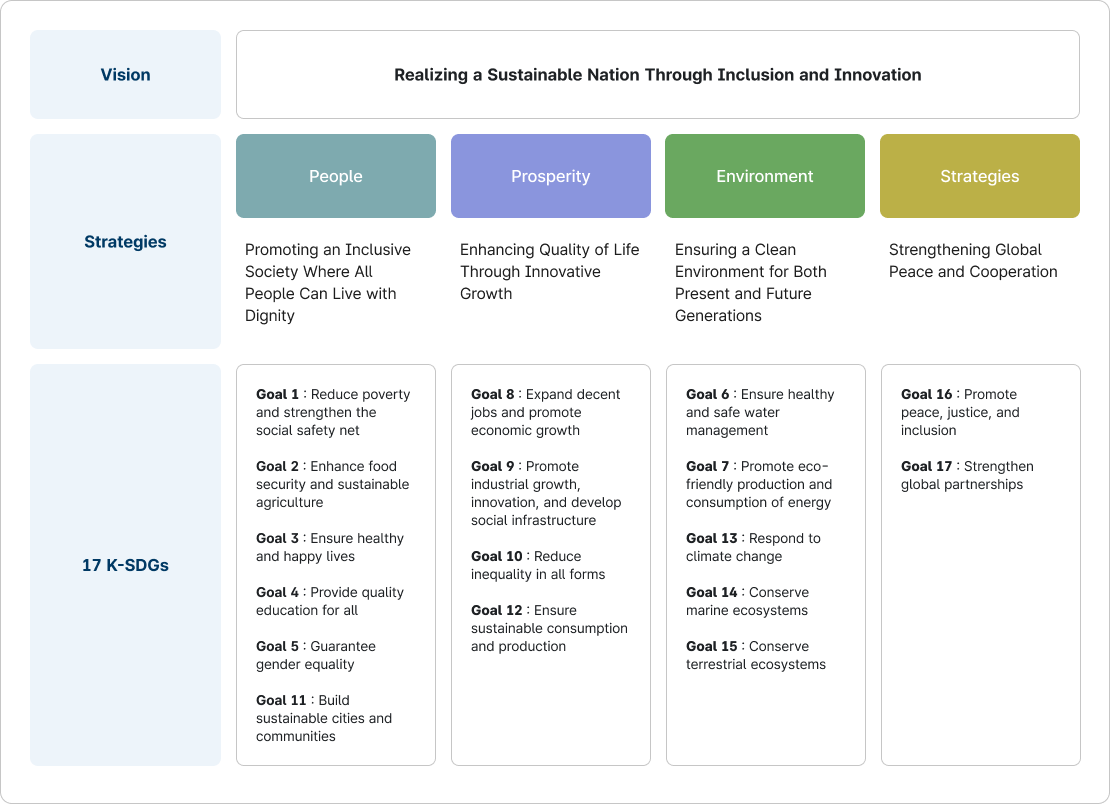
The 4th Basic Plan for Sustainable Development, adopted in 2020, aims to achieve sustainable development in harmony with future generations. Based on input from diverse societal groups, it encompasses the forward-looking objectives of the K-SDGs and associated indicators. The K-SDGs encompass four major strategic areas—People (Social), Prosperity (Economic), Environment, and Peace & Cooperation—along with 17 goals, 119 targets, and 236 indicators to achieve these strategies.
K-SDG Vision and Strategies
K-SDG Vision and Strategies Under the 4th Basic Plan for Sustainable Development
Establishment Process
The K-SDGs were formulated through a bottom-up process with the participation of relevant government ministries, private-sector working groups, various stakeholders, and the general public. The government developed the K-SDGs through joint public–private–academic working groups, in consultation with inter-ministerial bodies—including the Ministry of Environment, the Ministry of Economy and Finance, the Ministry of Land, Infrastructure and Transport, and the Ministry of Education—and with support from working-level task forces.
Throughout this process, the government served as a facilitator by providing forums for social dialogue and compiling the outcomes of discussions, while the actual goal-setting was led by joint public-private-academic working groups organized for each SDG.
Notably, the K-SDGs were finalized after undergoing a comprehensive social dialogue process through the national SDGs forum and public surveys, and ultimately approved at a Cabinet Meeting.
![Ministerial Consultative Bodies: ·23 ministries including the finance and economy, education, and health and welfare ministries. Social ministerial Meeting/Cabinet Meeting: Director-Level Committee(presided by the climate, energy and enviroment minister) ·[Formation] SDGs-related ministries. ·[Operation] Quarterly. *Assistants: The education ministry, the climate, energy and environment ministry and the data and statistics ministry. Working-Level T/F(manageral meeting presided by the climate, energy and environment director) ·[Formation] SDGs-related ministries. ·[Operation] Monthly(more if needed). *Assistant: The eduction ministry, the climate, energy and environment ministry and the date and statistics ministry. Social Dialog: ·National SDG Forum(roundtable). ·Public Survey. Joint Working Groups of the Private, Public, and Acade mic Sectors: ·420 people including civic group experts, industry experts, public officials, state researchers, and professors. Stakeholder Groups(K-MGoS): ·Persons with disablity, women/families, youth, teenagers, workers, farmers, migrants, animal protection, industries, science and technology, education/academia, local communities, and local governments](../../img/ksdgs_process.png)